Forex Terms Every Beginner Must Know Before Trading
Stepping into the world of forex trading can feel learning a new language. every successful trader started exactly where you are now—at the beginning, trying to make sense of what “pips,” “lots,” “spread,” “leverage,” and “margin” even mean.
Understanding Forex terminology isn’t just helpful; it’s essential. These terms lay the foundation for making informed, confident trading decisions. the most important forex terms every beginner must know before entering the market. The explanations are written in simple, just clear and practical understanding.
What is Lot Size?
Lot size represents the volume of your trade. This determines how much each pip is worth.
- Standard $1 lot = 100,000 units
- Mini 0.1 lot = 10,000 units
- Micro 0.01 lot = 1,000 units
Beginners usually start with mini or micro lots to manage risk better. Choosing the right lot size is part of smart risk management. Your lot size directly affects how much each pip movement — which impacts your potential gain or loss.
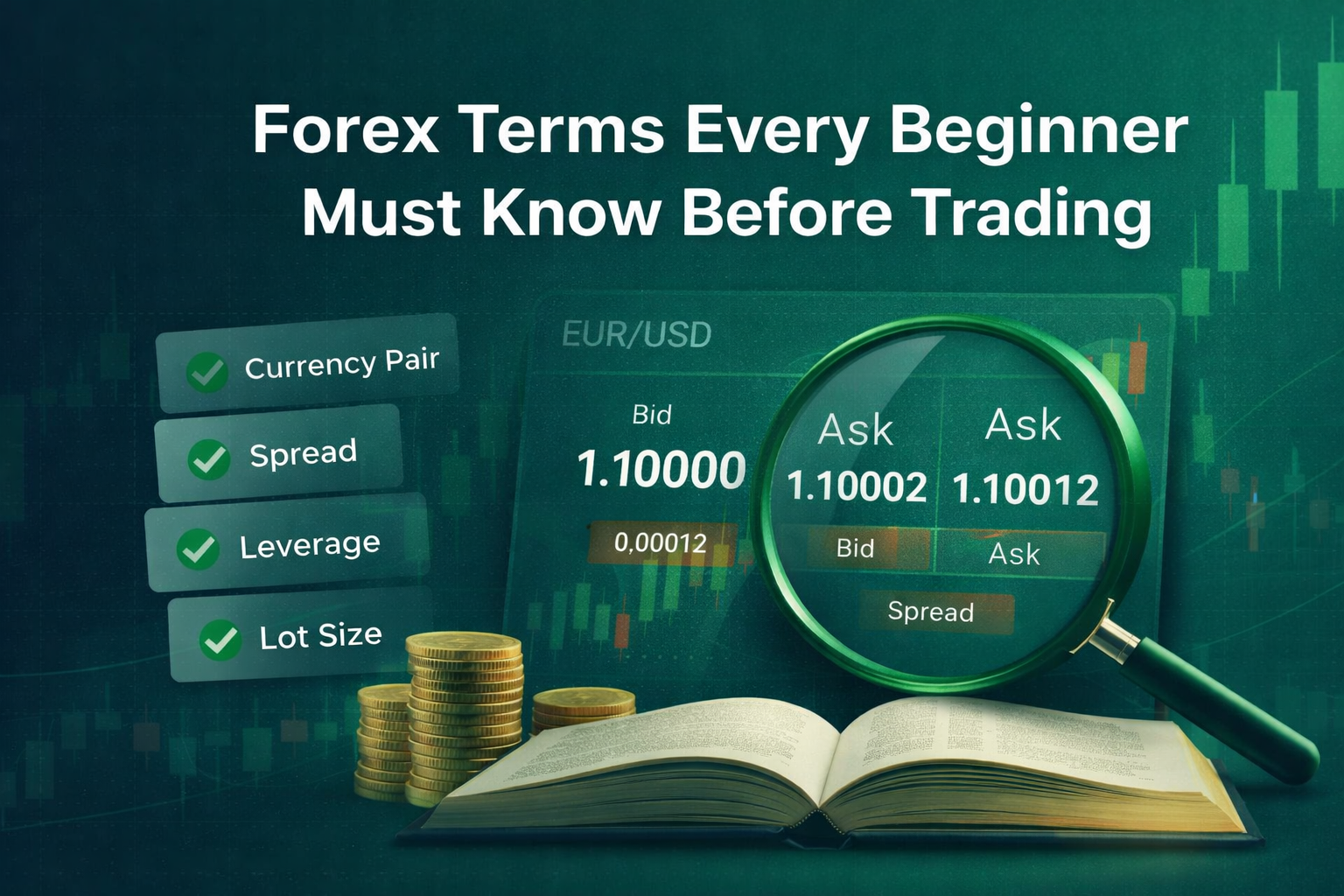
What is Bid and Ask Price?
When you open your trading platform, you’ll always see two prices:
- Bid Price: The price at which you can sell
- Ask Price: The price at which you can buy
The difference between them is known as the
spread.
What is Spread?
The spread is essentially the broker’s fee. Spread is difference between the bid price and the ask price.
- Tight spreads = lower cost
- Tight spreads usually occur in highly liquid pairs like EUR/USD.
- Wide spreads = higher cost
- Wider spreads are common in exotic or less-traded pairs.
You can think of the spread as a built-in trading cost. Tight (small) spreads mean lower costs to open a trade, which is ideal for beginners. Understanding spreads helps you gauge trading costs more clearly.
What is Pip? (Percentage in Point)
A pip measures the smallest unit of price movement in a currency pair. pairs quoted to four decimal places, one pip equals 0.0001.
- Most pairs: 1 pip = 0001
- If EUR/USD moves from 1.1000 to 1.1015, that’s a 15-pip
- JPY pairs: 1 pip = 01
- if USD/JPY moves from 145.50 to 145.80, that’s a 30-pip
It matters because:
- Profit and loss are calculated in pips.
- The spread (trading cost) is measured in pips.
- Every trading strategy relies on understanding pip values.
Simple rule:
More pips in your favor = more profit.
What is Leverage, Margin & Margin call?
Leverage
Leverage allows you to control a large position with a small amount of capital. Different Brokers offers Different leverages for example, 1:100, 1:500, 1:1000, and 1:1500.
Example # 1, using
1:100 leverage means a $100 deposit can control a $10,000 position.
Example # 2, using
1:100 leverage means $100 in the market for every $1 you invest.
Leverage is powerful but risky. leverage can amplify profits, it can also magnify losses just as quickly.
Beginner tip: Start with low leverage until you’re confident with your strategy and risk management.
Margin
Margin is the amount of money your broker requires you to open and maintain a leveraged trade. Think of it like a security deposit. If your trade moves against you too much, you risk receiving a
margin call. Meaning you must deposit more funds or risk your position being closed automatically.
Margin call
A margin call happens when your account no longer has enough money to maintain your open positions. Brokers alert you or automatically close trades to prevent your balance from going negative.
What is Take-Profit (TP) & Stop-Loss (SL)?
Take-profit (TP) order automatically closes a trade when it hits your target profit.
Stop-loss (SL) automatically closes your trade when the price moves against you. It’s your best friend as a beginner.
A good trader always knows where to place their
(TP) &
(SL) before entering a trade.
What is Fundamental & Technical Analysis?
Fundamental Analysis Focuses on economic factors like interest rates, Inflation, unemployment data, GDP reports, and political events.
Technical Analysis uses charts, indicators, technical tools and patterns to forecast price movements.
Combining
technical and
fundamental analysis often leads to better trading decisions. Most traders use a mix of both.
Conclusion
These basic terms act like a roadmap, helping you navigate the market with more confidence and less confusion. Forex terms may seem like a small step, but it’s one of the most important steps for any beginner. It’s the foundation of becoming a confident and informed trader. When you know what pips, lots, margins, and spreads truly mean, you gain the clarity needed to make smart decisions.
Enroll Now for Our Trading With Market Sentiment Program!
If you want to know more about Risk Management & Intraday Trading Strategies, you can refer to our previous blog on
Importance of Risk Management in Trading and
10 Best Intraday Trading Strategies.
Open a Demo Account using our link to get support from us –
https://track.deriv.me/_7NlWI72Z2uXOnQYcsG-vA2Nd7ZgqdRLk/1/ and send your ID to info@capitalgainsacademy.com
Happy Learning
!